
Do you ever wonder what it takes to design and develop technologies for complex military platforms?
Do we spend hours inside a LAV every day to understand its unique intricacies?
How do we test our products to ensure they work when it matters most?
Advancements in technology have allowed us to level up our testing capabilities significantly over the years. Digital twinning in particular has given us the opportunity to represent physical devices, environments, or users that we don’t have regular access to in a controllable and reproducible manner.
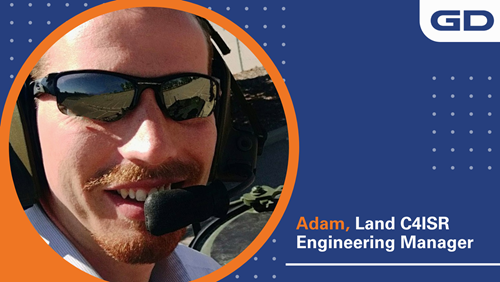
We sat down to chat with Adam Dove, Land C4ISR Engineering Manager, to learn about his experience in leveraging digital twinning for testing at scale and some of the associated benefits.
“We’ve done a lot of work with middleware – software that interfaces with various devices on a Canadian Army vehicle, like a LAV or TAP-V. It can be difficult to coordinate access to the vehicle for testing purposes and typically we would have to go out to an integration event travelling to a Canadian Forces base,” explains Adam.
As you can imagine, this is a relatively costly, restrictive, and logistically complicated task, so what we’ve been able to do is create digital representations of these vehicles with their unique sets of hardware and represent the interfaces of the vehicle equipment and sensors without having to take our equipment and plug it into the actual vehicle. We have the ability to take information and lessons learned from these integration events, and bring it back to the lab. This data allows us to refine our vehicle simulator; better representing its physical equivalent.
“The benefit is that our time to market is faster – we can do some pretty impressive integration in a very short amount of time because of the digital twin environment. While we certainly can’t replace the value of end-user engagements, we can augment them and better prepare, so that when we show up we have a high degree of confidence that things are going to work,” he shares.
Inevitably, there are some differences between the actual equipment versus the documentation for the equipment. If we know we have followed the documentation really closely and we’ve tested it, we then can use our time in-person with the vehicle to focus on those differences. Even if we can’t work them all out in our time allotted with the vehicle, we will capture what the discrepancies are and can focus on them back in the lab.
“By improving our simulators with recorded data essentially using a true to life representation of the actual devices we have improved our ability to remove defects prior to fielding. We work around flaws that may not be captured in an interface control document, and largely increase the quality of our products which directly improves the end user experience,” explains Adam.
In our Mobile Domain System Integration Lab, we have gone so far as to create a digital representation of real users for Voice Simulation Analysis Testing. By recording actual soldiers or our own Mission Specialists going through communications protocols, we have built a library of data that we can feed back into our system. We use this data for reproducible testing both at a small scale and for larger, more complicated tests. We feed it through various networks for voice communications so we can measure the degradation from test to test with the exact same audio sequence through different patterns. Having that reproducible representation of our users allows us to tweak and tailor some of our methodologies and parameters by removing the less reproducible human in the loop.
“This can range from having a handful of vehicles actively communicating with each other through simple point to point, or point to multipoint pathways, or we can scale it for complex voice tests of up to 60 vehicles, exercising communication pathways that include multiple hops in transmission,” says Adam. “Through the digital representation of actual users, we can accurately repeat the same tests, release to release for consistent comparison and accurate improvement measurement.”
One of the key advantages of the digital twin environment is the ability to measure an impact on end user experience as we scale from simple vehicle to vehicle scenarios, up to brigade-level vehicle deployments. We’ve actually created a convoy simulator which allows us to do robustness, performance, and stress testing of our products by simulating the data traffic from hundreds of vehicles at the same time.
Adam explains that beyond these clear tangible benefits, the use of digital twinning also allows us to give precious time back to our customers.
“When we do these integration events on base or on-site with other OEMs, it’s not just us, it’s the Army as well, and we need to take soldiers and their equipment away from their day-to-day duties to do these events. If we can lessen the need for lengthy in-person testing, we can allow them more time to focus on their military priorities.”